Marinscope
A 2020 Marin County case involving vandalism of a statue of Saint Junipero Serra has been resolved through a restorative justice solution brokered by the Marin County District Attorney’s Office.
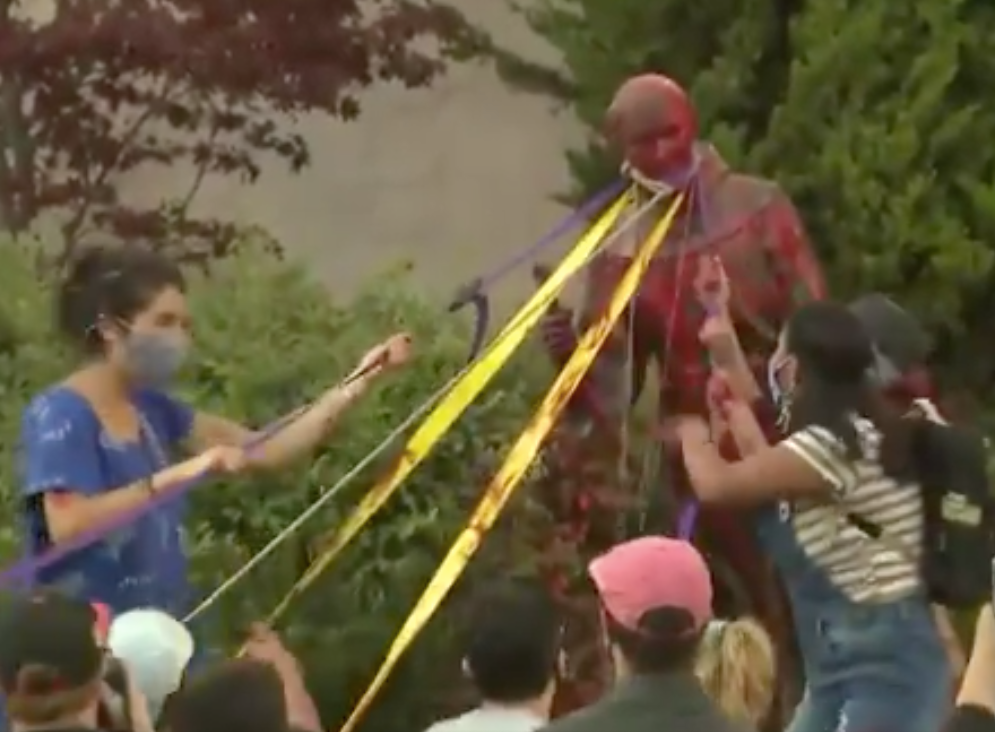
Five people were arrested after the statue honoring the 18th century Catholic icon was destroyed during a planned protest at Saint Raphael Catholic Church on October 12, 2020. The DA’s Office filed felony vandalism charges against all five defendants in November 2020.
The five charged in Marin County Superior Court were: Ines Shiam Gardilcic, 40; Victoria Eva Montanopena, 29; Melissa Aguilar, 36; Mayorgi Nadeska Delgadillo, 36; and Moira Cribben Van de Walker, 25. The defendants have participated in restorative justice while the case was making its way through the court system.
Marin County Superior Judge Geoffrey Howard approved a resolution reached by Deputy District Attorney Aicha Mievis, Marin County DA Lori E. Frugoli and the defendants’ legal counsel, announced May 25. Frugoli said the resolution came after a thorough case review by prosecutors and a long discussion among church members, community members, legal counsel for the defendants and the defendants’ participation in the Restorative Justice Process guided by Rochelle Edwards of the Transformative Justice Institute.
The agreement reduces all charges from felonies to misdemeanors. The defendants must also:
– Pay monetary restitution, an amount determined by the Marin County Probation Department, to the church for the repair or replacement of the statue.
– Complete 50 hours of volunteer work.
– Apologize in writing as part of the official court record.
– Participate in a community forum to be held in the coming months with a credible historian who will give stakeholders a chance to have a meaningful dialogue about the issue.
– Stay off the church property.
“It is the District Attorney’s Office’s goal to achieve a fair result on all cases, and I strongly believe justice was served on this one,” Frugoli said. “While this issue has raised emotions because of the sensitivities around religion, community boundaries, and historic inequities, the fact is that a resolution through accountability has been reached through restorative justice and that is a victory for this community.”
Frugoili in a press release announcing the no-jail- agreement, said “Father Serra, a Spanish-born Franciscan priest, is a controversial figure in California history. He established the system of Catholic missions starting in 1769 and he died in 1784. Mission San Rafael Arcangel, which contains Mission Saint Raphael Catholic Church, was the second-to-last in the chain of 21 missions. Serra was canonized by the Pope in 2015.
The Spanish army were sending native Americans back to Spain to serve as domestic servants breaking up communities and families in the process.
The Franciscans were trying to educate the Native Americans so that the Spanish Government would see them as civilized and therefore it would be immoral to make them slaves and separate them from their
families and communities.
Formal schoolroom education was not normal or natural for the Natives and so the Franciscans had to be somewhat heavy handed in their discipline as it was a matter of time and urgency that the natives become as civilized as they needed to be to satisfy the Spanish government representatives who came to judge their ability to manage their own (Native Americans) survival according to
Spanish perspectives.
The Franciscans did what they could to educate Natives who were much like children in order to assure that they remained on their land and with their families.